
Carl Hopgood Proves Heartbreak is Best Served Glowing
Updated: Sep 4, 2025
Turns out heartache has great lighting. Carl Hopgood should know. After all, he’s spent years turning personal history, cultural memory, and a sly sense of theatre into objects that seem to glow from within.

Whether it’s neon declarations, sculptures assembled from the relics of other people’s lives, or intimate portraits that catch him in moments between poise and vulnerability, Hopgood treats light as both a tool and a co-conspirator. In front of Stefan Pinto’s lens, that philosophy becomes literal — heartbreak reframed, beautifully lit, and impossible to look away from.

Emerging from Wales and polished at Goldsmiths, Carl Hopgood builds worlds out of neon, nostalgia, and found objects. His sculptures—think precarious stacks of chairs lit with sharp neon slogans—are loaded with personal history and emotional detonations.
In works like Just Say Gay, he meets political outrage with glowing defiance . Other pieces, like the breathing “Sleeping Figure” (a plaster cast animated by projected film), blur the line between life and art.
Hopgood’s art has bounced from London galleries to L.A., where his pop‑culture‑charged vision has landed in collections like Museo Jumex, The Palm Springs Museum of Art, the Groucho Club, and even Morgan Freeman’s.

Hopgood’s work has always lived at the intersection of emotion and precision. His mixed-media installations, often constructed from reclaimed or discarded objects, transform into vessels of memory. A chair becomes more than a chair; it becomes the ghost of every person who ever sat in it.
“Everybody’s got a memory of their grandparents or a lost loved one that might have sat in a chair that is no longer here, but the memory of them is always there,” he says.
It’s a reminder that his art isn’t about nostalgia for nostalgia’s sake, but about capturing the trace of human presence — and giving it a stage.

This portrait series, shot in varied light and tone, pulls Hopgood out of the gallery and into a cinematic frame. Here, he’s not just the maker of the work — he is the work.
Pinto’s photographs lean into that duality: the public-facing artist with an exacting vision, and the private individual caught mid-thought.

In the above photograph from Stefan Pinto’s Smoke and Mirrors solo exhibition in Hollywood, Carl Hopgood reclines shirtless inside a tanning bed, bathed in saturated purple light that transforms the scene into a hyper-stylized tableau. Wearing aviator sunglasses and a gold pendant, he casually holds open Vanity Fair featuring Meryl Streep — while a beer in a stemmed glass sits within arm’s reach on a towel embroidered with red script. Playful details, like the tiny pair of pink tanning bed eye protectors, add an undercurrent of absurdity to the glamorous setting, perfectly embodying the exhibition’s theme of image, illusion, and self-aware spectacle.

Sometimes Hopgood is composed, suited, framed by the gleaming architecture of downtown Los Angeles. Other times, he’s sprawled on textured fabric, a half-shadow across his face, the sort of candid intimacy that can’t be staged — or at least, looks like it can’t be.
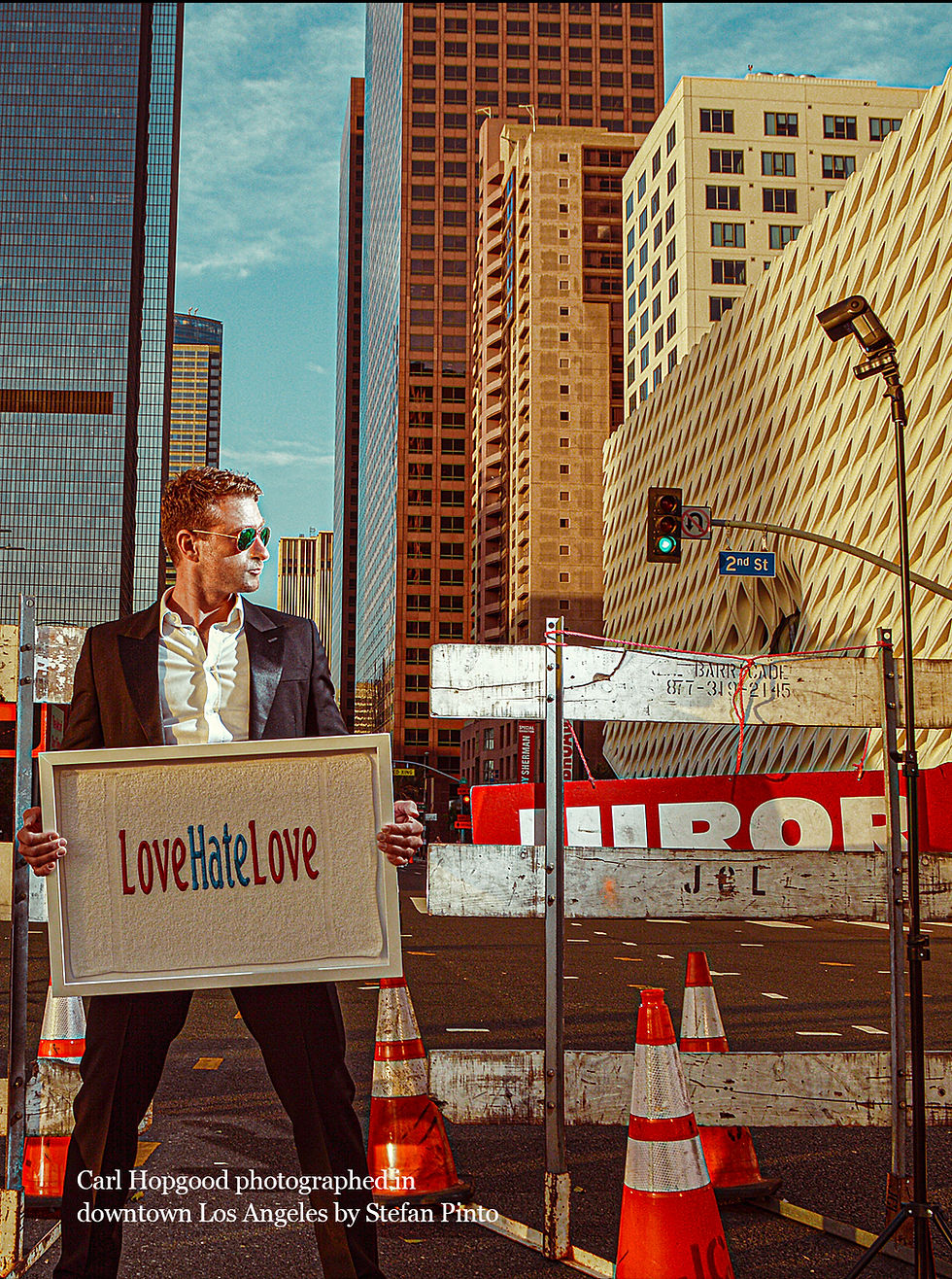
There’s a thread here that runs deeper than just good portraiture. It’s about performance and vulnerability in equal measure. Hopgood’s art often invites you to step closer — to read the words in neon, to consider the object’s history — and these images do the same.

They offer the viewer that moment of pause, the space between surface and substance, where the light does more than illuminate. It lingers, just like the memory.

11 Questions I Asked Carl
1. What’s the most surprising thing someone has said while standing in front of your work?
Charles Saatchi squeezing behind my Sculpture “shower piece” at the Goldsmiths college degree show. It was a 16mm film projected on a marble figure standing in a tiny shower cubicle only meant to be seen from behind. He almost knocked it over wanting to see the front; curiosity got the better of him. Luckily I got there just in time.
2. Which do you find harder — starting a new piece or finishing one?
I think finishing an art work is much easier as its based on an emotion like an ephemeral feeling of knowing when to stop.
3. Has anyone ever completely misunderstood one of your works in a way you secretly enjoyed? One of my collectors is RHOSLC housewife, Bronwyn Newport, and she bought my art work “You Changed My Life.” They filmed her installing it on the show. The art work caused so much heated debate, someone sent me the podcast “The Vile Files” where the host Nick Vile was making a joke about my art and Bronwyn Newport’s taste in art and one of the guests @justinkaphillips defended it in such a brilliant "can I give you a history lesson” way, even saying how much he admired that it was a ready made homage to Duchamp. I loved the way he nailed it.
4. What’s the one non-art object in your studio you couldn’t live without? My Nespresso coffee machine!
5. If you could borrow one artwork from any museum, no questions asked, which would you choose?
Andy Warhol silver floating pillows.
6. Which comes first for you — the concept, or the materials at hand?
I’m a conceptual artist so always the concept.
7. What’s the one thing you hope people take away from your work?
Inspiration.
8. If I walked into your studio and rearranged something, would you notice immediately?
I have ADHD, so yes!
9. When stacking chairs in a sculpture, do you ever worry someone will actually try to sit in one? No as they look so precarious and unstable.
10. What’s the one thing you hope people feel walking away from your work — besides wondering how you got the chairs to stay like that? An emotion.
11. Finally, if heartbreak has great lighting, what does falling in love look like?
It's feels intoxicating like being drunk In love. (Note: Drunk In Love is the title of one of Hopgood’s neon artworks currently on display at Madsen Gallery).
